Central America 7 Love Them & Hate Them

 Chicken buses are also habitually visited by street vendors who will ride the bus to the next stop or town while they push their merchandise onto a captive audience. They are selling everything from beauty product to snacks and cold drinks, and even entire meals consisting of rice, chicken and tortillas, all of which are served in a small plastic bags.

The vendors are of all ages from very young children to elder men and women; all are very persistent and persuasive. When the bus is crammed with people standing in the aisle, the vendors will artfully weave their way down the aisle to offer their products to every person on board.

Aracely Castellani (to be continued)

Central America 6 Entertainment on Buses


From what I’ve seen, people transport just about everything on the buses, and I’m convinced they are essential to the economy of these countries. Without these old American school buses, I am guessing 90% of the population wouldn’t go anywhere, since owning a vehicle is a luxury only the wealthy enjoy.

There is also an entertainment value to the whole experience to be quite frank. In each bus there is usually a driver and a conductor. The conductor collects the fares, helps passengers with their carry on baggage, and hangs off the side of the bus yelling the bus route to everyone passing by. He also skillfully gets on and off at each stop while the bus is still in motion to help anyone that may need it. The baggage brought on the buses is anything from a sack of coffee, fruits and vegetables, chickens and anything else that can be sold at a market.

Aracely Castellani (to be continued)

Central America 5 Local Culture on Buses

 Finally, riding on a chicken bus is a unique way to experience the true culture. As I mentioned, this is the primary and daily mode of transportation for locals. These buses stop everywhere, and frequently, which adds additional time to your journey. The system acts like veins in a body, connecting the tiniest isolated town to the rest of the country. 

To get from one location to the next, depending on how far you want to go, you may have to make several transfers, but it could potentially be the same story with the tourist shuttles. Everyone rides them including school children, farm workers, teachers, market and street vendors, all making their way to the populous cities. From what I’ve seen, people transport just about everything on the buses, and I’m convinced they are essential to the economy of these countries. 

Aracely Castellani (to be continued)

Central America 4 Safety on Buses


 Then there is safety. I have read many chicken bus theft stories on multiple web forums and I am grateful that Jason and I have yet to experience anything like that. But, I must say that thus far, we have felt extremely safe on the road. We even prefer the buses over taxis; I guess we just feel more safe in numbers. Our bags are usually right next to us, near us or in plain view of us. We do practice precaution and try to be aware of our belongings and surroundings and we carry a money belt for cash, passports and credit cards. I know that we can’t control every situation and the possibility exists of getting our things stolen, but if we allowed negative possibilities to dictate our life we wouldn’t be traveling in these foreign countries in the first place.

Aracely Castellani (to be continued)

Central America 3 Little Comfort


Only focusing on our trip from Antigua to Panajachel to Semuc Champey, which is about 164 miles, we spent $69.22 in total. That’s a $35.52 savings and an additional 64 miles distance for riding the local buses. That’s the value of two nights in a hostel and a meal. This is what budget travel is about, finding the cheapest alternative.

Second, each time we hopped in a tourist shuttle we were just as cramped, if not more than on a chicken bus. These transportation companies are definitely not concerned with the comfort level of their passengers. They will squeeze 5 of us into a 3 seat row bench and most either don’t have or don’t use air conditioner during the 8 hour journey. Furthermore, if the road conditions are bad, unless you’re in a Mercedes-Benz S-class, your ride will be bumpy on both a chicken bus and a shuttle.

Aracely Castellani (to be continued)

Central America 2 Cheap Local Transportation


 Depending on what kind of traveler you are, you either avoid them or take advantage of them whenever possible. In our case, Jason and I have a love hate relationship with the chicken buses. We love them because they are cheap, just as uncomfortable as a tourist shuttle, safe and we get to experience the culture of a country up close and personal.

First, let’s talk numbers. As a concrete example, we spent $33.70 between the two of us on transportation from the entrance of the Salvadorian boarder to the entrance of the Honduran border, which is approximately 228 miles. In comparison, while in Guatemala, we often traveled in tourist shuttles, with the exception of getting from Monterrico Beach to the boarder of El Salvador.

Aracely Castellani (to be continued)

Central America Chicken Buses


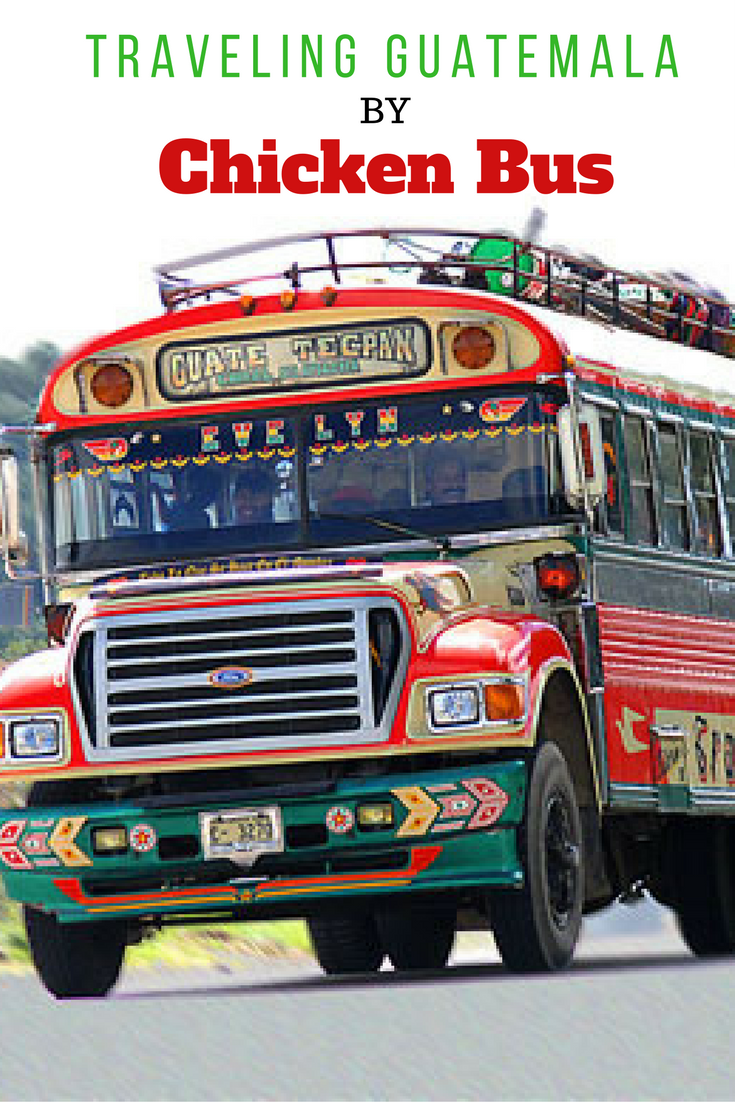
Culture and art is best represented in Central America by the old American school buses that have customized and painted in glaring colors. The art on these buses is taken seriously.

As a kid growing up in the USA, I, like the majority of the student population, rode a big yellow bus to school every morning. Back then, never did I imagine that later in life I would be making my way down Central America in that same type of transportation. Only this time, the colors and creative modifications of the bus are kaleidoscopical.

Old American school buses, affectionately referred to as “Chicken Buses,” are the primary mode of transportation throughout all of Central America.

Aracely Castellani (to be continued)